Table of Contents
- Quick Answer: Is Clenbuterol Banned In 2026?
- What Is Clenbuterol?
- Why WADA Lists Clenbuterol As An Anabolic Agent
- How Clenbuterol Drug Testing Works
- What Is An AAF vs. an ATF?
- Why Meat Contamination Still Matters In 2026
- Strict Liability: Why Athletes Carry The Risk
- Practical Food Safety Steps For Athletes
- Supplement And Medication Risks
- What To Do After A Clenbuterol Finding
- Final Thoughts
Clenbuterol remains one of the most important substances for athletes to understand in 2026 because it sits at the center of anti-doping rules, drug testing, meat-contamination cases, and performance-enhancement debates. Some people still discuss it as a cutting drug or physique aid. However, for tested athletes, the key issue is simple: clenbuterol can create a serious anti-doping problem.
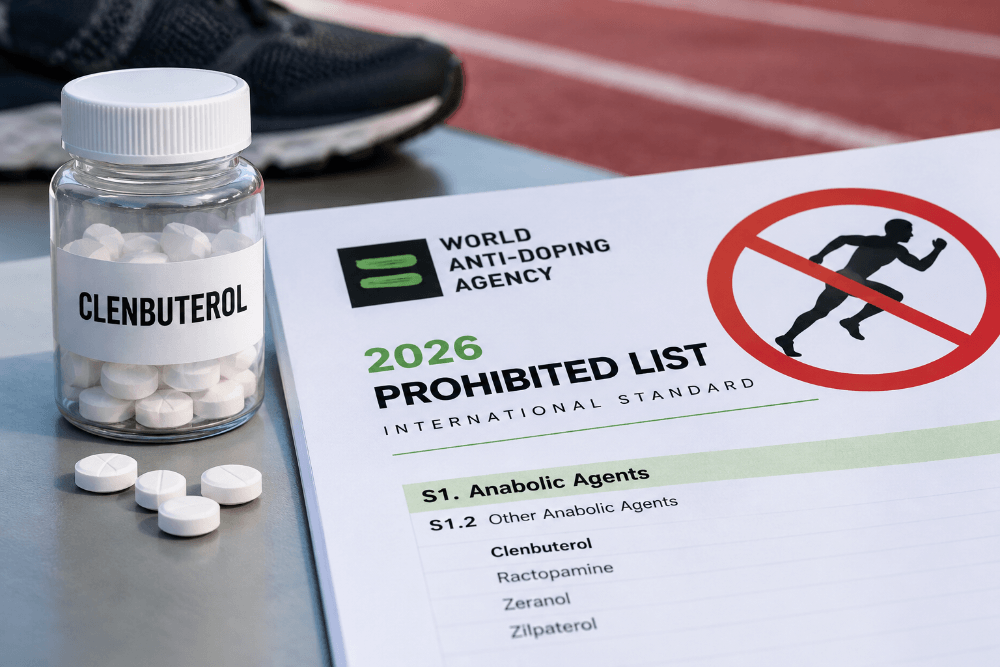
WADA’s 2026 Prohibited List includes clenbuterol under S1.2 Other Anabolic Agents, and the category applies at all times, both in-competition and out-of-competition. That means an athlete cannot treat clenbuterol as a substance that only matters near competition day. It can matter during training, travel, recovery periods, and off-season testing.
Additionally, clenbuterol creates a unique challenge because some positive or trace findings may involve contaminated meat in certain regions. Therefore, athletes need to understand both sides of the issue: intentional use remains prohibited, while accidental exposure can still require evidence, documentation, and investigation.
Quick Answer: Is Clenbuterol Banned In 2026?
Yes. Clenbuterol is prohibited under the 2026 WADA Prohibited List as an “Other Anabolic Agent” in section S1.2. WADA lists anabolic agents as prohibited at all times, which means both in-competition and out-of-competition use are banned.
This matters because clenbuterol is sometimes confused with ordinary asthma medications. Although it belongs to the broader beta-agonist family, WADA does not treat clenbuterol like permitted inhaled beta-2 agonists with dosing limits. Instead, WADA places it in the anabolic-agents category, alongside substances such as ractopamine, SARMs, zeranol, and zilpaterol.
So, for athletes, the practical answer is direct: do not use clenbuterol unless your anti-doping authority has given clear, valid, written guidance that applies to your specific case.
What Is Clenbuterol?
Clenbuterol is a long-acting beta-2 adrenergic agonist. In some contexts, similar drugs can affect airway smooth muscle. However, clenbuterol also affects metabolism, skeletal muscle signaling, heart rate, and the nervous system.
Because of those effects, some people misuse clenbuterol for fat loss, cutting, or performance-related goals. However, the health risks are significant. Poison Control notes that clenbuterol is not FDA-approved for human use in the United States and can cause rapid heart rate, palpitations, tremors, anxiety, low potassium, elevated blood sugar, seizures, and cardiac arrest.
For athletes, medical and anti-doping concerns overlap. A substance that can affect performance, body composition, and cardiovascular function naturally attracts attention from anti-doping programs.
Why WADA Lists Clenbuterol As An Anabolic Agent
Many athletes find this confusing because clenbuterol is not an anabolic-androgenic steroid. However, WADA’s prohibited categories do not rely only on street labels or gym terminology. The 2026 Prohibited List places clenbuterol under S1.2 Other Anabolic Agents, not under the ordinary beta-2 agonist section.
This classification matters because some bodybuilders describe clenbuterol as “not a steroid,” which can make it sound less serious. However, “not a steroid” does not mean “allowed.” It also does not mean “safe.”
Recent human research has added more context to why clenbuterol remains under scrutiny. Studies have reported effects on lean mass, strength, muscle protein accretion, and cardiorespiratory fitness. Therefore, anti-doping authorities treat clenbuterol as more than a simple stimulant or bronchodilator.
How Clenbuterol Drug Testing Works
Anti-doping laboratories commonly test urine samples for prohibited substances and their markers. Clenbuterol can appear in urine after exposure, and laboratories use sensitive analytical methods to detect very small amounts.
Because clenbuterol falls into a non-threshold prohibited category, athletes should not assume that “a little bit” is automatically safe. However, WADA has created special reporting instructions for very low concentrations of certain substances known to appear through possible meat contamination.
This is where the process becomes more complicated. A clenbuterol finding may become an Adverse Analytical Finding (AAF) or an Atypical Finding (ATF), depending on the reported concentration and surrounding facts.
What Is An AAF vs. an ATF?
An Adverse Analytical Finding usually means a laboratory reported a prohibited substance or its marker in a sample. An AAF can lead to a results-management process, provisional suspension, investigation, and possible sanction.
An Atypical Finding means the result requires further investigation before authorities decide whether to pursue it as an anti-doping rule violation. In clenbuterol cases, this distinction matters because of potential meat contamination.
WADA’s Technical Letter TL23 states that urine findings for clenbuterol, ractopamine, zilpaterol, or zeranol at 5 ng/mL or less should be reported as an ATF, even though the likelihood of contaminated meat decreases as the concentration gets closer to that limit.
Importantly, an ATF does not automatically clear the athlete. Instead, the results-management authority must investigate whether contaminated meat is more likely than not to explain the finding.
Why Meat Contamination Still Matters In 2026
Clenbuterol meat contamination remains a real anti-doping concern because the drug has been used illegally or as a livestock growth promoter in some places. WADA’s TL23 notes clenbuterol use in China, Guatemala, and Mexico for cattle, lamb, poultry, and swine.
USADA also warns athletes about meat contamination risks and identifies countries and regions where clenbuterol use in livestock has been a known concern, including China, Mexico, Guatemala, and possibly parts of Latin and South America.
Therefore, athletes traveling internationally should treat food risk as part of anti-doping risk management. This does not mean athletes should panic about every meal. However, it does mean they should plan carefully when competing or training in higher-risk regions.
Strict Liability: Why Athletes Carry The Risk
Under anti-doping rules, athletes generally remain responsible for what enters their bodies. This principle, often called strict liability, means intent is not always the first question. If a prohibited substance appears in a sample, the athlete must help explain how it got there.
This can feel unfair in contamination cases, but it remains central to the system. Therefore, athletes should focus on prevention and documentation before a problem occurs.
For example, athletes should keep meal receipts, travel records, hotel information, team food plans, supplement batch records, and communication with team staff. If a trace clenbuterol finding occurs, those details may matter during the investigation.
Practical Food Safety Steps For Athletes
Athletes cannot eliminate every risk, but they can reduce exposure risk with better planning.
Helpful steps include:
- Use team-provided meals when available
- Choose reputable restaurants and hotels
- Avoid untraceable street meat in higher-risk regions
- Keep receipts and meal records during travel
- Ask teams or event organizers about food sourcing
- Avoid organ meats or unusual meat products when risk is unclear
- Travel with approved nutrition support when allowed
- Document supplements, medications, and food changes
Additionally, athletes should speak with their national anti-doping organization, team doctor, or anti-doping officer before travel to high-risk regions.
Supplement And Medication Risks
Although meat contamination gets attention, athletes should not ignore supplement and medication risks. Unregulated performance, fat-loss, bodybuilding, or “cutting” products may contain undeclared substances. Therefore, be skeptical of any product promising rapid fat loss or stimulant-like effects.
When possible, athletes should use batch-tested supplements and keep records of lot numbers, purchase receipts, and certification details. However, even third-party testing doesn’t eliminate all risk. It only reduces risk.
Medication risk also matters. Athletes should never assume a drug is allowed because it comes from another country, a gym contact, or an online seller. They should check medications through trusted anti-doping resources and consult qualified medical staff before use.
What To Do After A Clenbuterol Finding
If an athlete receives notice of a clenbuterol finding, quick organization matters. The athlete should contact qualified anti-doping counsel or athlete-support staff, preserve records, and avoid guessing publicly.
Useful records may include:
- Food logs from the relevant period
- Restaurant receipts and menus
- Travel itinerary and hotel details
- Team meal plans
- Supplement and medication records
- Photos of meals or packaging
- Communications with team staff
- Any information about local food-safety risks
If the result falls under an ATF investigation, evidence may determine whether authorities treat contaminated meat as the more likely explanation or move the case forward as an AAF.

Final Thoughts
Clenbuterol in 2026 remains a major anti-doping risk for athletes. WADA lists it as an anabolic agent prohibited at all times, and sensitive testing can detect very small amounts. At the same time, WADA’s technical guidance recognizes that low-level findings may sometimes require investigation because of possible meat contamination.
Ultimately, athletes should treat clenbuterol as both a prohibited performance-risk substance and a contamination-risk substance. Do not use it; avoid unverified supplements and cutting products; plan meals carefully in higher-risk regions; and keep detailed records while traveling. In anti-doping, prevention and documentation often matter as much as training and competition preparation.